In this article we go through the wedding traditions and customs that are a popular part of a wedding day in Czechia and explain what they mean. Some will be familiar from weddings anywhere, others are typically Czech, which is worth knowing if you are marrying here or are a guest at a Czech wedding. We have ordered them the way they fit into the wedding day, from the engagement to the wedding night. At the end we added a few customs that are not so traditional but might suit your wedding.
Engagement
Today an engagement is mainly a matter for the couple themselves. What must not be missing is a ring with a stone and a romantic place or moment. The wedding usually takes place within a year of the engagement.
TIP: It still holds that the future groom should come and ask the bride’s parents for her hand, and bring flowers for her mother.
Wedding invitations
Wedding invitations or announcements will delight your loved ones. You can hand them over in person, send them by post or electronically. In the past, the invitation in Czechia came with wedding kolaches (small round pastries with a sweet filling) or Christmas-style biscuits, for even more joy.
Printed invitations are definitely a custom that pleases parents and grandparents most, who will probably keep them. These days, though, paper is either complemented or fully replaced by a wedding website, which is cheaper and more practical.
TIP:
How to create a wedding website
Hen and stag party
The farewell to single life, usually organised by the witnesses, is an essential part of a Czech wedding. It normally takes place one or two weeks before the wedding. In the past it was a sedate event at the bride’s and the groom’s homes. Today it is nothing unusual to fly abroad for it, even for longer than one night.
The wedding dress
By tradition, the groom should not see the bride’s dress before she walks up to the altar. According to the superstition, this protects the newlyweds from bad luck. The bride also should not sew her wedding dress herself: supposedly she would sew up her path to happiness and the marriage would not last long.
TIP:
Something old, something new, something borrowed, something blue
You probably know this tradition, and it is still kept today. With something old the bride leaves her old life behind. With something new she welcomes the new one. Something borrowed is said to bring luck to the marriage, and something blue stands for the bride’s innocence and faithfulness.
Something given as a gift is often added too, and it can become a lovely keepsake of the wedding day.
The veil
According to legend, the veil stops evil spirits from entering the bride’s body. Today veils are seen less often, mainly because they have to go with the hairstyle and the dress.
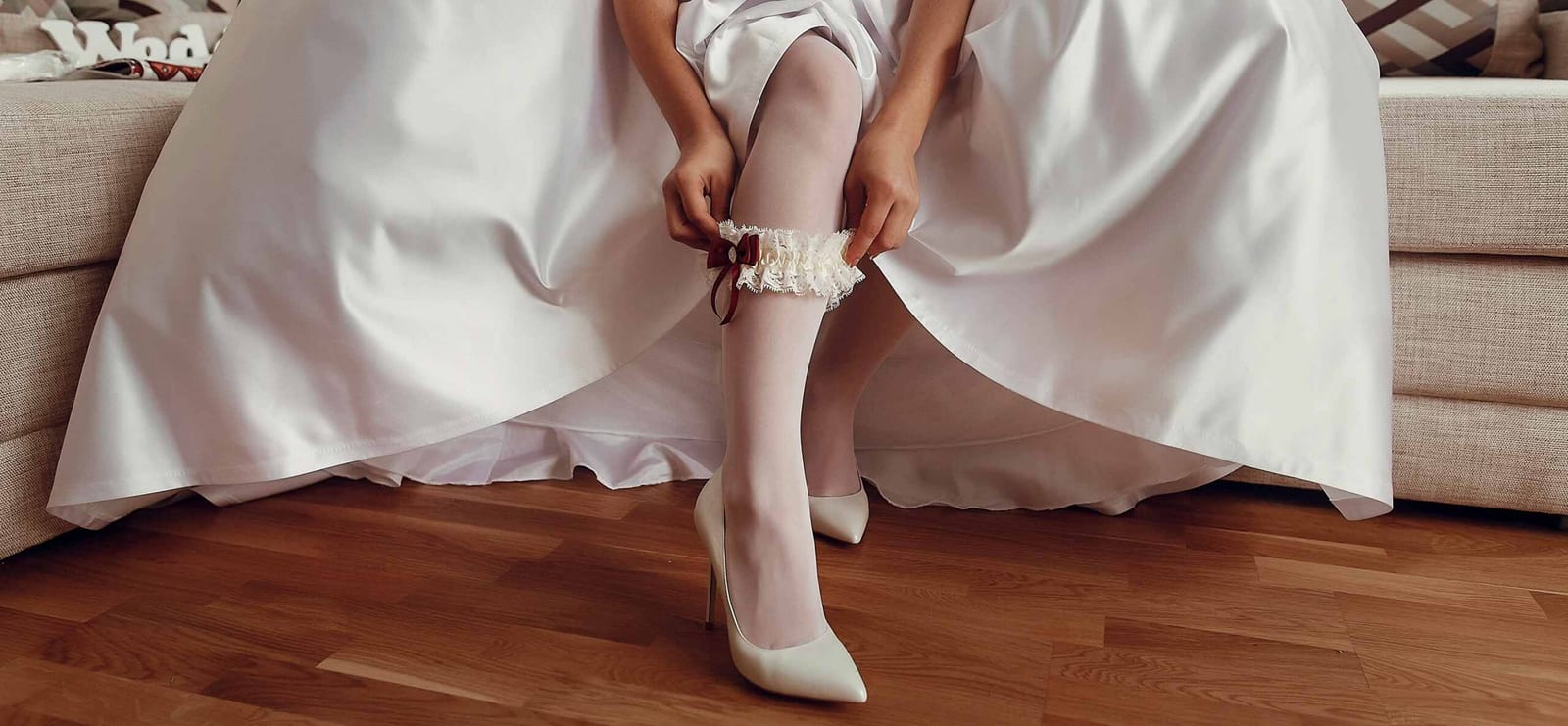
The garter
The garter mostly plays the role of something blue. Blue stands for faithfulness and purity (after the Virgin Mary).
The wedding convoy and honking
According to custom, the groom arrives at the ceremony first and the bride last. After the ceremony they leave together, first. In the past people cracked whips; today the convoy of cars honks its horns. The noise is meant to drive away evil spirits.
Bridesmaids
Bridesmaids should be unmarried girls. According to superstition, they confuse the evil spirits that want to pounce on the bride. That is why the bridesmaids’ dresses should look similar to the bride’s, so the spirits cannot tell them apart.
Wedding myrtle
You will probably see small ribbons with a sprig of myrtle at every Czech wedding. They are pinned on the invited guests to mark them out. The groom and the best man usually wear a small buttonhole of flowers instead of myrtle.
The bridal bouquet
According to tradition, the bride should only see her bouquet on the wedding day, after the groom brings it to her.
TIP:
How to choose a wedding bouquet
A path of petals
Bridesmaids or little girls can scatter petals along the aisle for the bride to walk on. The flowers symbolise fertility.
Exchanging rings
A custom no wedding can do without. Wedding rings confirm the union, faithfulness and an unbreakable bond. The endless circle stands for endless love. They have been worn on the left ring finger since ancient Roman times, when people believed a vein ran from it straight to the heart.
TIP:
The guard of honour and throwing rice
After the ceremony the guests form a guard of honour, a lane the newlyweds have to walk through. It symbolises their shared journey through marriage, which should be free of trouble. Guests usually throw rice, confetti and petals at the couple as a symbol of wealth and fertility.
TIP: Check with your venue in advance what you can and cannot throw.
The wedding toast
By tradition, the wedding toast is given by the bride’s father, or by one of the witnesses.
Sweeping up the shards
At the start of the reception a plate is broken at the newlyweds’ feet, and the staff usually take care of this part. The shards bring luck and the noise once again drives away evil spirits. Sweeping them up together shows the newlyweds that they should work together, not only when solving problems but also at home.
Wedding kolaches
The only rule for wedding kolaches (small round Czech pastries with a sweet filling) is that the bride should not bake them herself, or she will have trouble in her marriage. The kolaches are usually wrapped up for guests to take home.
Soup from one plate
Another test of teamwork for the newlyweds, usually at the start of the wedding lunch: the bride and groom get a large bib tied around their necks and feed each other soup from one plate (sometimes even with a spoon full of holes). The single plate symbolises sharing equally in marriage.
Cutting the wedding cake
Cutting the cake together is a popular tradition that is rarely missing. Like the other shared activities, it stands for sharing equally and working together. The groom gives the first piece to the bride, the bride gives the second to the groom. Then the bride should give a piece to the groom’s mother and her own, then come the fathers, and after them the guests.
The first dance
The first dance belongs to the newlyweds. It used to be a waltz; today it is often a carefully rehearsed choreography. During the dance the other guests should form a circle around the couple and hold hands. After their dance the parents join in, then the other guests. It usually opens the party.
Wedding games
Wedding games are mainly there to entertain the guests and fill the quiet moments. Among the most common are the shoe game quiz and a wedding raffle.
TIP:
The best wedding games in one place
Tossing the bouquet
Almost everyone knows the bouquet toss and what it means. The single women stand behind the bride, who throws her bouquet to them. Whoever catches it is said to be “next in line”. If the bride does not want to throw her own bouquet, she can have a copy made specially for this custom.
The wedding night
In the past the wedding night revolved around the bride’s virginity and was often nothing the young couple looked forward to. The bedroom was searched before the night in case the bride had hidden a small bottle of blood to protect her honour. The newlyweds wore wedding shirts so they would not see each other naked, and the bloodstained sheet was even hung out after the wedding night to prove her purity to the whole village. Fortunately things are more relaxed today. Often the newlyweds do not get much out of the wedding night at all: after such a long day, all they want is the bed and sleep.
Carrying the bride over the threshold
Carrying the bride over the threshold symbolises a new life in a shared home. According to superstition, by carrying her the groom tricked the evil spirits lurking under the threshold. They did not notice her, and by the time they woke up she was already part of the household, so they could not harm her. This tradition is not only for weddings, it also applies when you buy a new house, for example.
The wedding candle
In the past a candle was lit during the ceremony and people watched its flame. A calm flame meant a peaceful marriage, and the other way round.
Releasing doves
Releasing doves from the hands of the bride and groom is a modern wedding tradition. Doves have only one partner in their lifetime, which is why they became a symbol of endless pure love and faithfulness.
Blocking the way
This Czech tradition, called zatahování, is mostly up to the groom’s friends. After the ceremony they block the newlyweds’ way with a stretched rope hung with all sorts of things to do with marriage. They only let the couple pass once the groom pays a ransom. According to superstition, he buys himself free of his sins.
The horse collar
A popular, slightly mischievous tradition, mainly among the groom’s friends. After the ceremony a horse collar (chomout) is fastened around the groom’s neck, symbolising the bond of marriage. The bride then gets a whip, to make it clear who will be in charge.
Ball and chain
More mischief from the groom’s friends. They fasten a prisoner’s ball to his leg, locked with a padlock, symbolising the sins of his past. The bride gets a hacksaw and has to set her husband free. Here too the power of money works: the groom can bribe his friends again and free himself.
Kidnapping the bride
Kidnapping the bride is a popular Czech wedding tradition. During the day the groom’s friends “kidnap” the bride and take her to a nearby restaurant. The groom has to find them and free her, which he does by paying the ransom: his friends’ bill.
TIP: It is a good idea to arrange the kidnapping in advance, for example with the coordinator or someone else helping with the wedding, so the bride does not vanish at the wrong moment, such as when it is time for photos or cutting the cake.
Water or slivovice?
The principle is simple. The newlyweds get two shots: one is water, the other slivovice (Czech plum brandy), and they do not know which is which. Whoever picks the slivovice will, according to superstition, rule the relationship.
The fake bride
One of the funnier customs is the fake bride. Before the wedding one of the men dresses up as a bride and tries to seduce the groom. The fake bride usually only stops bothering him after getting a small reward, such as a bottle.
Choose your wedding traditions carefully
When planning your wedding and the traditions you want to include, think about where the wedding takes place, how many people will be there and how much time you will have for the customs. If it is not your own wedding, talk any plans through with someone who is helping to organise the celebration, so you can be sure you will not disrupt the day.